The Reading
What I read, and what I say next.
Where your company sits, what each part of it is for, what is holding the result back, and what I'd change. How the company is put together is read from the work itself, never from an org chart.
AI
AI reads your records. People make the decisions.
Scale
Build the operating system once. I keep it running.
Entity one and entity forty get the same reading. You retain authority at every step.
Operations
What I run each week
Each week I update one record of what was decided, what is out of bounds, what is ready, what was certified, what was approved and what was released.
What I capture today
as of 2026-09-24
Read today
- Google Drive
- Gmail subjects and timing
- Google Calendar
- Uploaded workbooks and exports
- Project-system exports
- Contracts as files
Told by you
- Who is allowed to approve what.
- The words you use for things.
- Corrections, on the record.
Not yet
- Nothing is written back into your systems.
- No message is sent on your behalf.
- No person is scored.
- Payments and benchmarks are not part of the product.
What you receive
The screens you work from.
Three screens, from the sample. Yours will carry your words and your records.
 Sample data
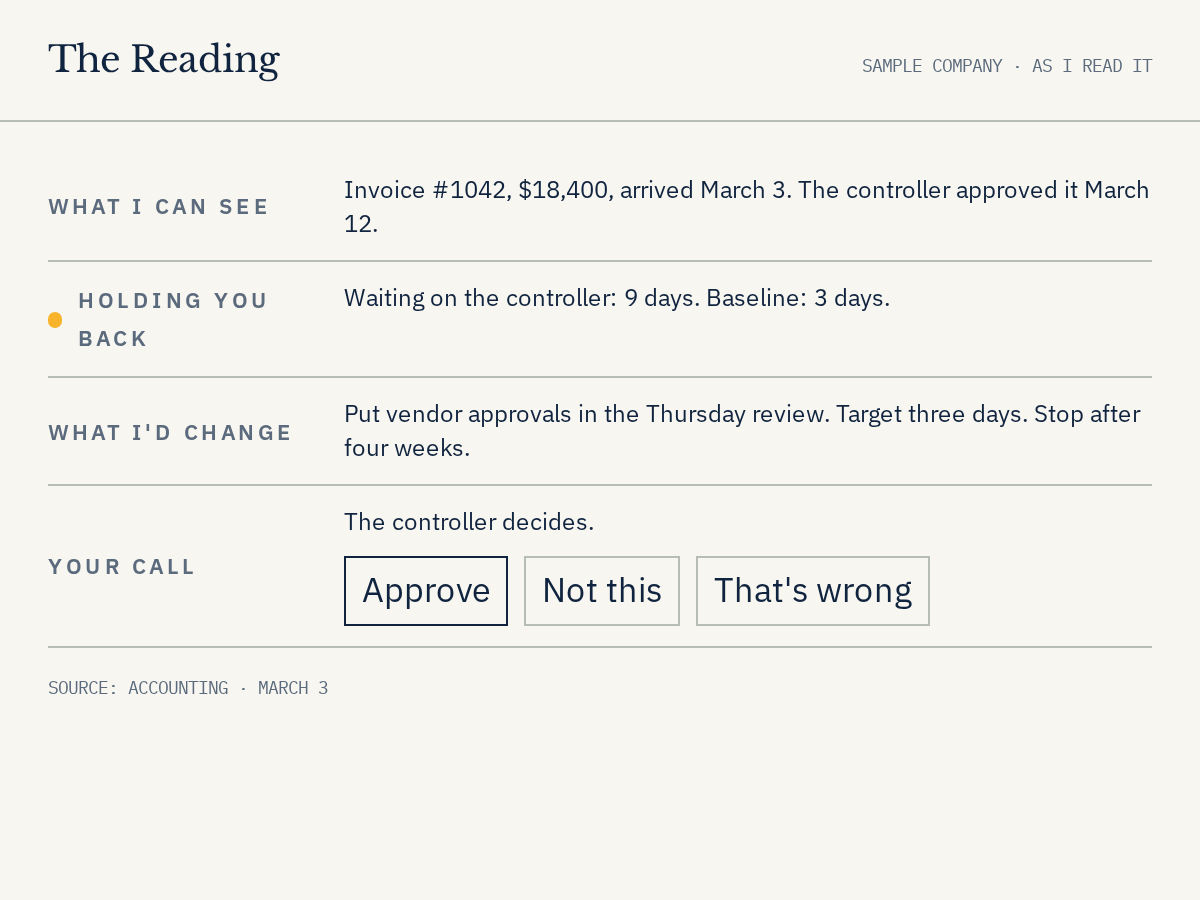
01The Reading: what I can see, what holds the result back against its baseline, and what I'd change. 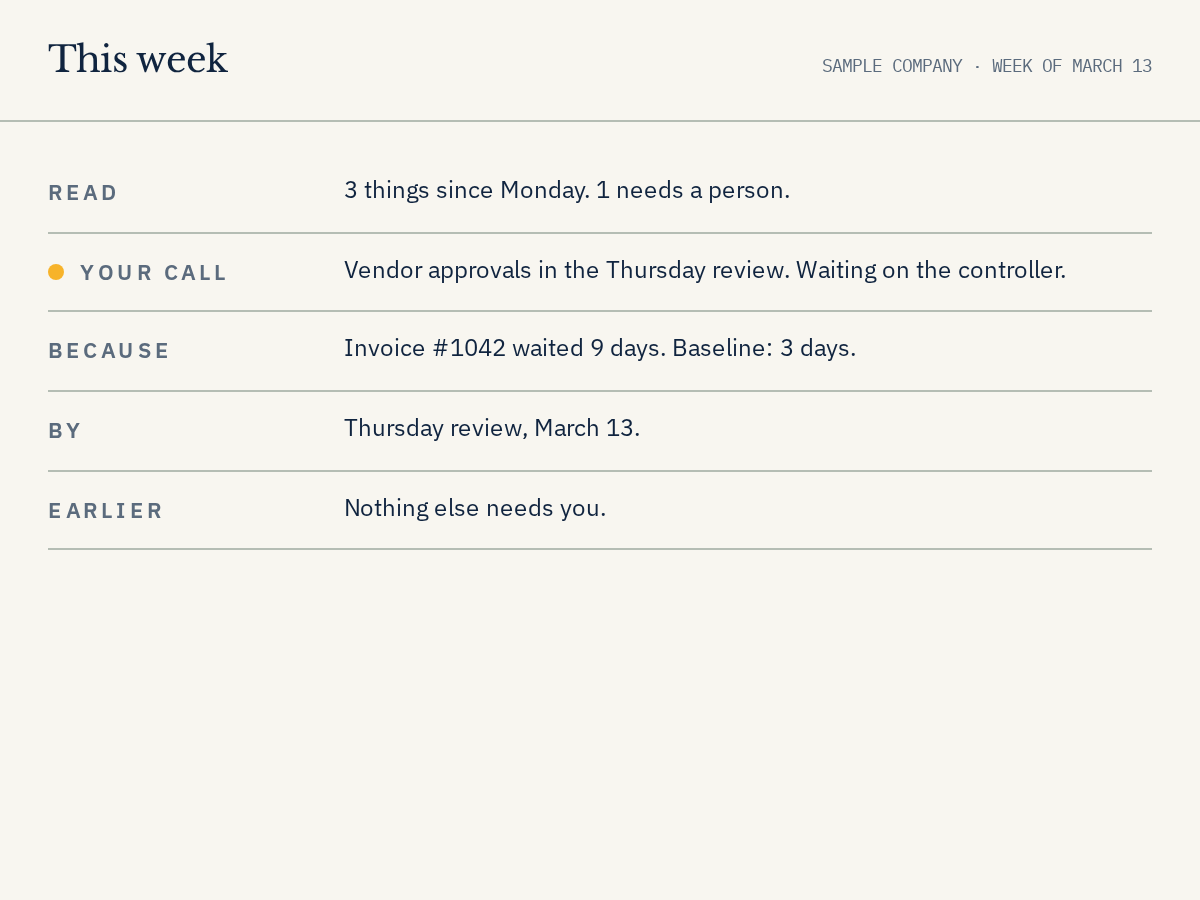 Sample data
02This week: one call waits on the controller before Thursday's review. 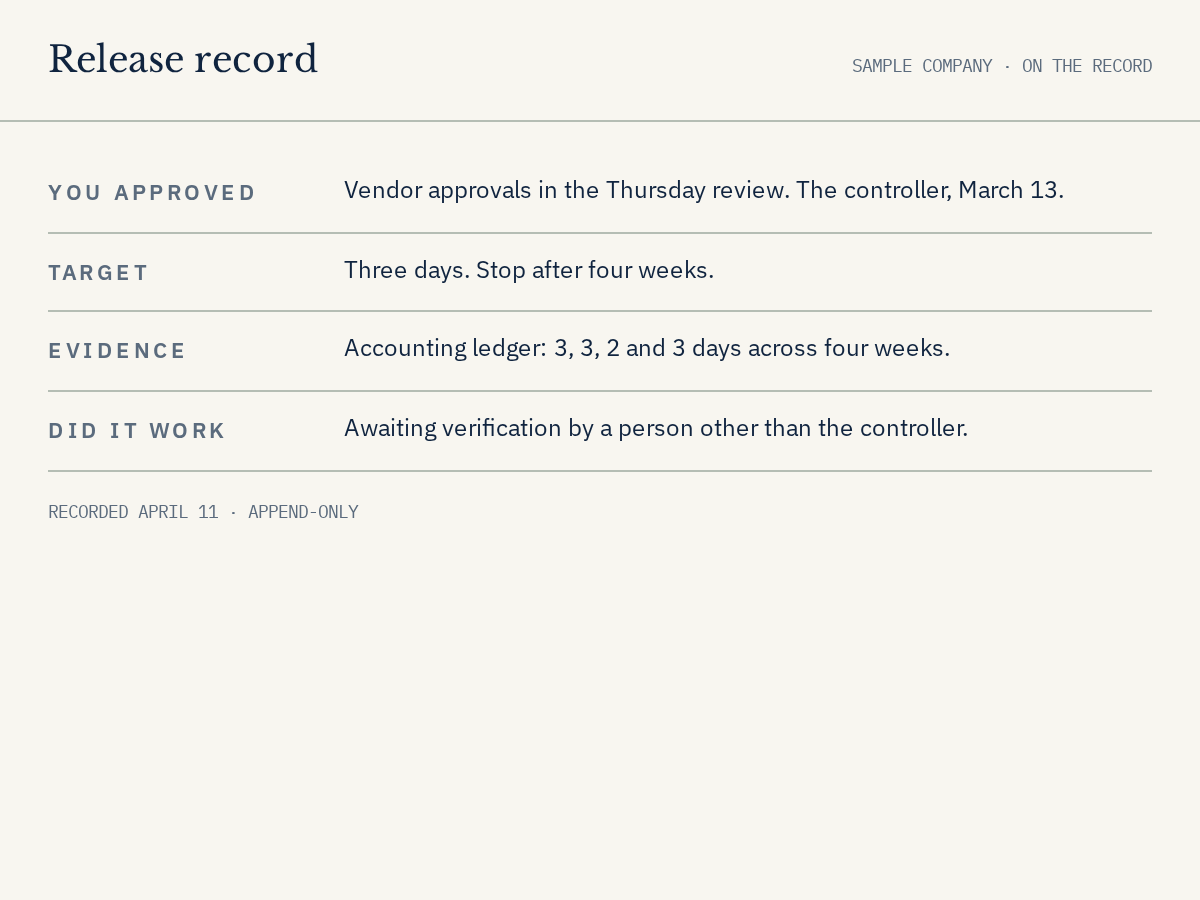 Sample data
03The release record: the approved change and four weeks of ledger evidence, kept as written.
Connect · Form · Find · Fix · Prove
The AI reads. You decide.
- 01
Connect
- What the AI does
- I read the records you permit.
- What you do
- You choose the boundary and the sources.
- 02
Form
- What the AI does
- I form how the company works from those records.
- What you do
- You correct the reading in your own words.
- 03
Find
- What the AI does
- I show what is holding the result back, with its baseline.
- What you do
- You decide whether it matters.
- 04
Fix
- What the AI does
- I propose one change, then carry the approved work and its evidence.
- What you do
- You approve the change and name its owner.
- 05
Prove
- What the AI does
- I compare the result with its baseline and say whether it was kept.
- What you do
- You verify whether it was kept.
How work actually moves
The people, systems and records work actually passes through.
Structure is read from observed flow, not from an org chart.
Detail
Select any part of the picture to read what it is and why it is shown.
I do not score employees or infer personal worth. I show how work moves, where it waits, how calls travel, and what was kept — with its source.
- Observed
- Waiting on
- Stopped on
- Kept
I do not score employees or infer personal worth. I show how work moves, where it waits, how calls travel, and what was kept — with its source.
Did it work
Read it back, and see what actually changed.
What moved today, the call you made, the work that followed, and whether it showed. No invented figures.
Change movie · OutcomeNeutral sample — no company data
- What changed
- The outcome was verified and the model updated.
- Why
- The graph learns from what happened, not from what was planned.
- Who was authorized
- Verified by a named person, separately from the doer.
- Evidence
- Verification attached; timing alone is never treated as cause.
- Outcome
- Verified.
- Observed
- Waiting on
- Stopped on
- Kept
Installation
Twelve weeks, if you go on to install
This is the shape of an Installation, not a promised outcome.
- 01
Weeks 1–2 · Connect
Map sources and ownership
Source map and work inventory
- 02
Weeks 3–4 · Form
Confirm how the company works
The story so far, with unknowns
- 03
Weeks 5–8 · Find and Fix
Name the constraint and design the change
The Reading and an approved change
- 04
Weeks 9–12 · Prove
Record completion and verify the result
Did it work, on the record
Where the method comes from
The questions are fifty years old. The evidence is new.
Find · Fix · Prove runs the focusing steps Eliyahu Goldratt set out in the Theory of Constraints: find the constraint, subordinate everything else to it, act, then look again. Consultants work these steps in workshops, from memory and interviews.
Here, every step must carry its records. A constraint is a count of what the record holds. A conflict is two sources, quoted. A change appears only when its trigger fired and its evidence is held. Nothing advances on my say-so.
Method after Goldratt's Theory of Constraints. The evidence-binding is mine.
The boundary
Bounded is not comprehensive.
A Reading shows what the evidence in front of it supports. It does not show the company.
- 01
Here is what the evidence shows.
- 02
Here is what it does not show.
- 03
Where is this wrong?
Those three lines open every early session. Unconnected activity stays unknown rather than being guessed at, and a correction from someone who was there outranks anything I assembled. Corrections are recorded against the claim they change, and the record only ever grows.
Scale
Then it scales
The Reading on one entity becomes the same Reading on every entity at Installation. The fixed fee is priced per entity.
Who runs it
The founder starts it with you. I keep it running.
Ongoing engagements are fractional operating leadership with an AI that keeps the record.
- Each week, the founder
- Runs your operating review as your fractional operating lead. Brings the one change to the person who decides. Keeps the registers honest.
- Each week, I
- Read the sources you permit. Update the registers. Draft This week and Your call. Compare every result with its baseline.
- Each week, you
- Decide. Name the owner. Verify what was kept.
Monthly, per company. Two ongoing engagements at a time.
- 01 · The Reading
- 02 · Installation
- 03 · Narraitive, ongoing
- 04 · Ongoing — fractional operating leadership
The next call